
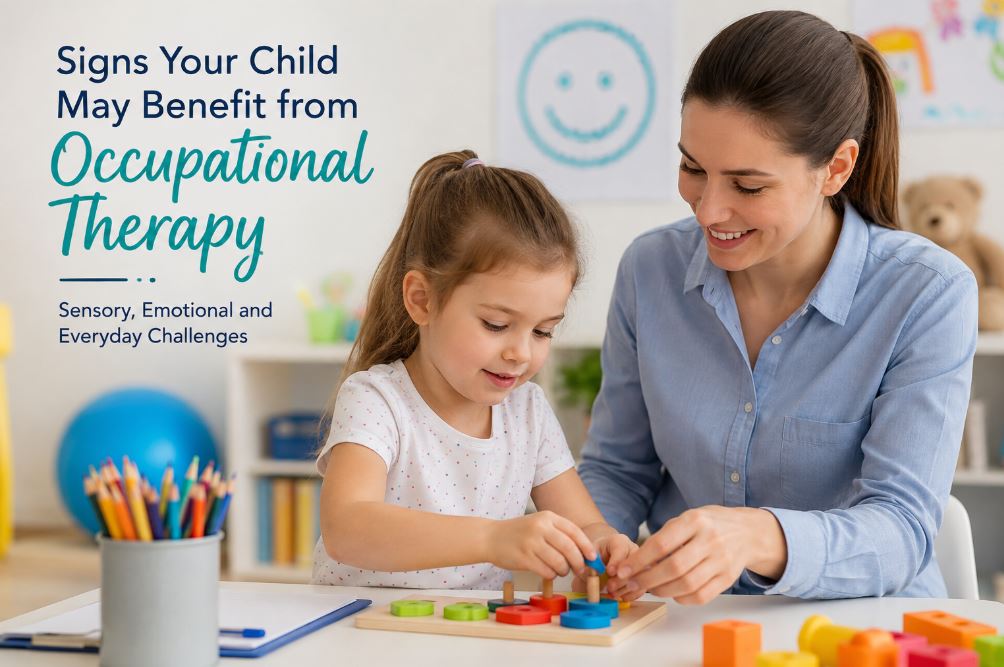
Every child develops at their own pace. Some children seem to move easily through everyday routines, while others may find certain tasks, environments or transitions much more challenging.
Perhaps getting dressed every morning regularly becomes a struggle. Your child may be unusually bothered by loud noises, clothing textures or busy environments. Handwriting might be difficult, sitting through class may take tremendous effort, or seemingly small changes in routine may lead to intense frustration.
Sometimes these challenges are temporary. But when they begin interfering with a child’s ability to participate comfortably and confidently at home, at school or in the community, pediatric occupational therapy may be worth considering.
Occupational therapists look beyond a single behaviour or skill. They consider how a child’s sensory, physical, cognitive and emotional needs may be affecting the everyday activities that matter to them.
At Breathe Wellness in Smithville, pediatric Occupational Therapy is available to support children and families throughout Smithville, West Lincoln and the surrounding Niagara region.
What Does a Pediatric Occupational Therapist Help With?
The word “occupation” may sound like it refers to a job, but in occupational therapy it means the meaningful activities that make up everyday life.
For children, those occupations include things such as:
- Getting dressed and ready for the day
- Eating and using utensils
- Playing independently or with other children
- Writing, drawing and using classroom tools
- Paying attention and participating at school
- Managing transitions between activities
- Following daily routines
- Regulating emotions and responses
- Participating in family and community activities
Occupational therapy focuses on helping children participate more successfully in these everyday activities.
An OT may assess the skills a child already has, identify barriers that are making certain activities difficult and develop practical strategies that can be used at home, at school and in other environments.
1. Everyday Sensory Experiences Feel Overwhelming
Children are constantly processing information from their surroundings—sounds, sights, textures, movement, touch, smells and even sensations from within their own bodies.
Some children process that information differently.
For example, a child may:
- Cover their ears around everyday noises
- Become distressed in crowded or busy environments
- Strongly resist certain clothing, seams or textures
- Avoid messy play or particular food textures
- Seek constant movement, jumping or crashing
- Have difficulty sitting still for meals or classroom activities
- Become overwhelmed more quickly than other children in similar environments
Sensory differences do not look the same in every child. Some children actively avoid particular sensations, while others continually seek additional sensory input.
The American Occupational Therapy Association notes that occupational therapy practitioners play an important role in assessing sensory processing challenges and helping people participate in activities at home, school and in the community.
When sensory responses consistently interfere with everyday life, an occupational therapist can help determine what may be contributing to the difficulty and identify strategies appropriate for the individual child.
2. Your Child Has Difficulty Regulating Their Emotions
All children become frustrated, upset or overwhelmed sometimes. Emotional regulation develops over time.
The concern is not simply whether a child has strong emotions. It is whether difficulty regulating those emotions is regularly preventing them from participating in everyday activities.
You may notice that your child:
- Becomes overwhelmed very quickly
- Has difficulty calming down once upset
- Struggles significantly with unexpected changes
- Reacts strongly to transitions
- Becomes frustrated by tasks that feel difficult
- Needs considerably more support than expected to recover after becoming upset
Sensory processing, emotional regulation and cognitive skills can interact in complex ways.
The Canadian Association of Occupational Therapists describes self-regulation as important to a child’s ability to participate safely and effectively in meaningful daily activities, while occupational therapy approaches may consider body, emotional, sensory and thinking factors together.
Rather than simply trying to stop a behaviour, an occupational therapist may work to understand why a particular activity or environment is difficult for the child.
That distinction can be important.
3. Getting Through Everyday Routines Is Consistently Difficult
Morning routines, bedtime, getting ready for school, mealtimes and personal care involve many different skills working together.
For some children, those seemingly ordinary routines can be surprisingly demanding.
Parents may notice challenges with:
- Dressing independently
- Fastening buttons or zippers
- Brushing teeth
- Washing or grooming
- Using utensils
- Organizing belongings
- Packing a school bag
- Following a sequence of tasks
- Moving from one activity to another
An occupational therapist can break a routine down into its individual components and identify where the difficulty is occurring.
The solution might involve developing a particular skill, changing how a task is approached, modifying the environment or creating strategies that make the routine easier to manage.
The goal is not perfection. It is helping the child become more comfortable, capable and independent in daily life.
4. Fine Motor Tasks Are Particularly Challenging
Fine motor skills involve the smaller muscles of the hands and fingers and are required for many childhood activities.
Signs that a child may be struggling can include difficulty with:
- Handwriting or printing
- Holding a pencil comfortably
- Using scissors
- Colouring or drawing
- Manipulating small objects
- Buttons, snaps and zippers
- Tying shoelaces
- Using forks and spoons
These challenges can become particularly noticeable once children begin school and are expected to complete more written work independently.
Occupational therapists can assess the underlying skills involved in these activities and recommend exercises, adaptations or alternative strategies to improve participation.
The Ontario Society of Occupational Therapists highlights the role OTs can play in helping students participate at school, including adapting classroom tools and supporting handwriting and other functional skills.
5. School Participation Is Becoming Difficult
A child can be bright, curious and capable while still having significant difficulty functioning within a classroom environment.
School requires much more than academic knowledge.
Children must be able to organize themselves, tolerate a stimulating environment, transition between activities, use classroom materials, maintain attention and interact with others throughout the day.
Some signs that additional support may be useful include:
- Difficulty remaining engaged with classroom activities
- Trouble organizing materials or completing multi-step tasks
- Handwriting that is especially slow or effortful
- Difficulty transitioning between subjects or activities
- Sensory overwhelm in noisy classrooms, assemblies or cafeterias
- Avoidance of certain school tasks
- Becoming exhausted or dysregulated after the school day
Occupational therapy does not replace educational support. Rather, an OT can help identify functional barriers that may be making it harder for a child to access and participate in their learning environment.
6. Attention and Executive Function Challenges Affect Daily Life
Children use executive functioning skills to organize themselves, begin tasks, remember instructions, shift attention and work toward a goal.
Difficulties in these areas may appear as:
- Frequently forgetting what they were asked to do
- Having trouble starting tasks
- Becoming distracted before completing an activity
- Difficulty organizing belongings
- Struggling with multi-step instructions
- Becoming overwhelmed when a task has several parts
- Having difficulty shifting from one activity to another
These challenges can occur for many reasons and are not unique to one diagnosis.
The Canadian Association of Occupational Therapists notes that sensory processing and executive functioning can be closely interconnected, which is one reason an OT assessment considers the child’s overall functioning rather than looking at a single behaviour in isolation.
7. Play or Participation With Other Children Is Difficult
Play is one of childhood’s most important occupations.
It is how children explore their environment, practise movement, develop problem-solving skills, communicate and build relationships.
A child may benefit from further assessment if difficulties with motor skills, sensory processing, attention or regulation regularly prevent them from participating in age-appropriate play.
An occupational therapist may help a child develop underlying skills while also modifying activities so that participation feels more achievable and enjoyable.
What About ADHD, Autism or Sensory Processing Differences?
Pediatric occupational therapy is commonly used to support children with ADHD, autism and sensory processing differences, but a child does not necessarily need a particular diagnosis before a family seeks occupational therapy support.
In fact, parents often begin by noticing a functional challenge rather than knowing its cause.
Perhaps handwriting is becoming a daily source of frustration. Maybe transitions are exceptionally difficult, the classroom environment feels overwhelming or basic routines require far more support than expected.
The focus of occupational therapy is ultimately on function and participation: what does the child want or need to do, what is making that difficult, and what can be done to help?
For neurodivergent children, contemporary occupational therapy increasingly emphasizes individualized and strengths-based care rather than trying to make every child behave or respond in exactly the same way.
Does One of These Signs Mean My Child Needs Occupational Therapy?
Not necessarily.
Children develop differently, and almost every child will struggle with some of these areas from time to time.
What matters more is the frequency, intensity and impact of the challenge.
Consider asking:
Is this preventing my child from participating in everyday life?
If sensory sensitivities, emotional regulation, fine motor skills, attention or routines are repeatedly making school, family life, play or independence more difficult, an occupational therapy assessment can help provide a clearer picture.
It can also give parents practical guidance instead of leaving them wondering whether they should simply “wait and see.”
What Happens During a Pediatric Occupational Therapy Assessment?
An occupational therapy assessment begins with understanding the child as an individual.
The occupational therapist may speak with the parent or caregiver about:
- The child’s strengths
- Areas that are creating difficulty
- Home and school routines
- Sensory preferences and responses
- Fine and gross motor abilities
- Attention and regulation
- Independence with daily activities
- The family’s goals and priorities
Depending on the child’s needs, the OT may also observe specific activities or use appropriate assessment tools.
From there, recommendations and treatment can be individualized around the child’s functional goals.
Importantly, occupational therapy often extends beyond what happens during an appointment. Practical strategies can be incorporated into everyday routines so that children have opportunities to build skills where those skills actually matter.
Pediatric Occupational Therapy in Smithville and Niagara
Families do not have to wait until a challenge becomes overwhelming before seeking guidance.
If you are noticing persistent difficulties with sensory processing, emotional regulation, attention, fine motor skills, school participation or everyday routines, speaking with an occupational therapist can help you understand what may be happening and what supports could be useful.
Breathe Wellness now offers Occupational Therapy in Smithville as part of our growing range of health and wellness services.
Our pediatric OT services are designed around each child’s individual needs, with a focus on helping children build skills, increase independence and participate more confidently in life at home, at school and in the community.
Families in Smithville, West Lincoln, Grimsby, Beamsville and surrounding Niagara communities can contact Breathe Wellness to learn more or determine whether an occupational therapy assessment may be appropriate for their child.
Contact Breathe Wellness to get started.